

 ENGLISH
 SPANISH
Essential Tips for First-Time Home Buyers in Orlando, FL: Your 2026 Guide
Orlando first-time home buyers in 2026 face a competitive but attainable market. According to Redfin, typical Orlando home sale prices in early 2026 ranged between $360,000 and $400,000, with properties often going under contract in under 30 days. This fast pace rewards preparation, clarity on budget, and careful neighborhood research. With strong employment anchors near Orlando International Airport and the University of Central Florida, ownership opportunities continue to attract renters ready for long-term stability.
How is the 2026 market shaping up for Orlando first-time home buyers?
Market conditions across Orlando in 2026 remain defined by limited resale inventory and steady demand. Data from the Orlando Regional Realtor Association indicates that months of supply has hovered near 2 to 2.5, well below the 6-month level considered balanced. This shortage affects areas from Lake Nona to the SoDo District, prompting many first-time buyers to expand search zones, consider townhomes, and act quickly when fitting properties appear.
Price growth has moderated compared with the rapid increases of 2021 and 2022, yet affordability still requires planning. Based on Zillow estimates for early 2026, Orlando home values have increased roughly 3% to 5% year over year, a slower but still meaningful rise. Neighborhoods close to downtown Orlando, such as Thornton Park and the Milk District, often command higher price-per-square-foot figures than outer suburbs along East Colonial Drive or near Clermont.
Interest rates remain a decisive factor. According to mortgage survey data compiled by Freddie Mac, average 30-year fixed rates in early 2026 generally ranged between 6% and 7%. That shift from the sub-4% era affects maximum purchase prices, especially for households targeting a monthly principal-and-interest payment near $2,000. Rate buydowns, adjustable-rate products, and temporary concessions have therefore become more common negotiation tools.
Local fundamentals continue to support ownership for Orlando first-time home buyers. Employers around Medical City in Lake Nona, the tourism corridor along International Drive, and educational institutions including Valencia College West Campus provide diversified job bases. Commute times of 20 to 35 minutes from many residential areas to downtown via State Road 408 or Interstate 4 remain attractive. These structural supports reduce long-term risk, even when short-term conditions feel intense.
Which Orlando neighborhoods suit first-time buyers best in 2026?
Several Orlando neighborhoods combine relative affordability with strong livability indicators. According to neighborhood data from Walk Score, areas around Mills Avenue and the Orlando Science Center achieve walk scores in the mid-70s, giving residents access to cafés, parks, and transit. Baldwin Park and adjacent Audubon Park often feature townhomes and smaller single-family homes that fall below the price points seen in lakefront pockets of Dr. Phillips or Windermere.
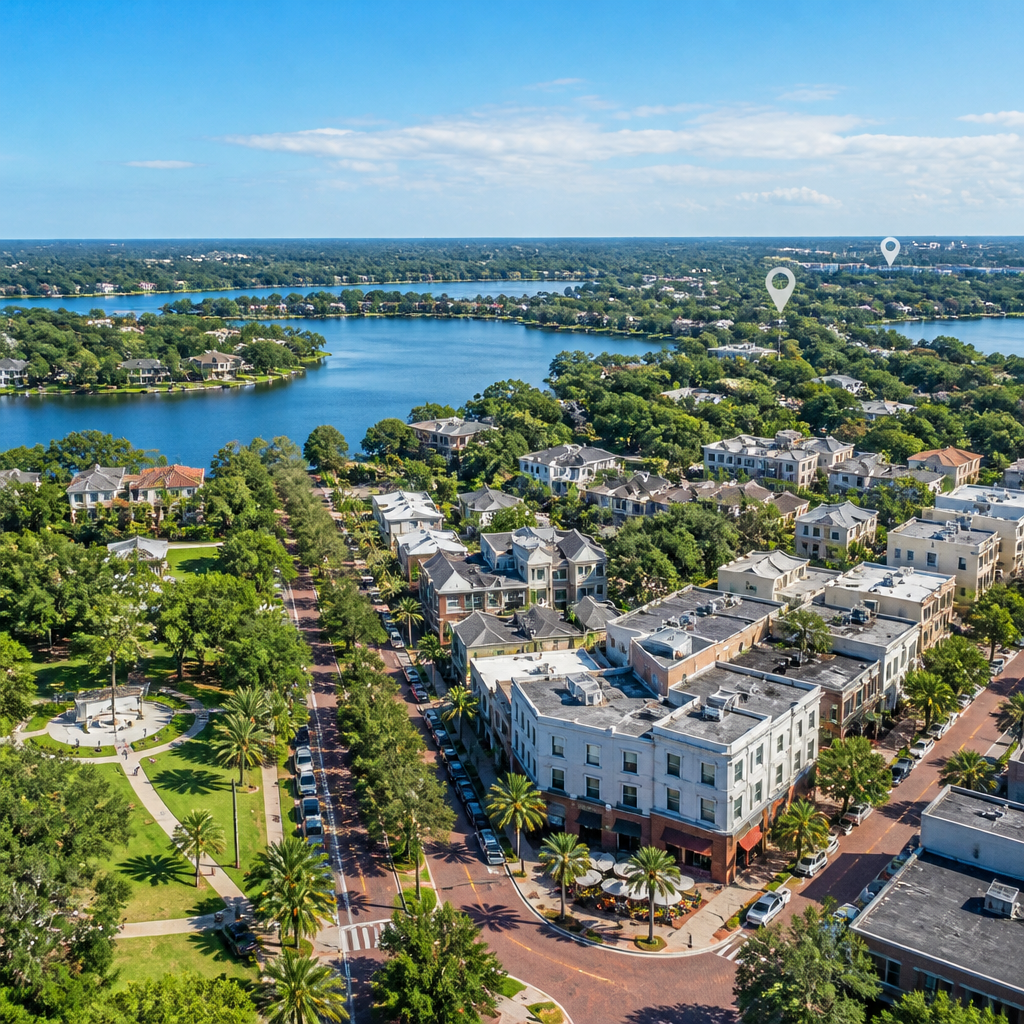
Late afternoons around Lake Eola Park often bring a mix of live music drifting from Washington Street bars and the scent of food trucks lining Central Boulevard. The glow from the Lake Eola fountain reflects off surrounding condo towers near Rosalind Avenue, while joggers circle the water and families feed the swans. That everyday atmosphere gives first-time owners in nearby condos a sense of city energy without the intensity of larger urban cores.
For buyers prioritizing school zones, parts of Conway and sections near Boone High School often gain attention. GreatSchools ratings show Boone High at roughly 7/10 as of 2026, according to GreatSchools. Similar interest surrounds Evans High School in northwest Orlando, rated around 5/10 but benefiting from ongoing investment and proximity to College Park amenities and access routes toward Camping World Stadium and downtown.
What financing options help Orlando first-time home buyers get started?
Financing structure often determines which neighborhoods remain realistic. The Federal Housing Administration program allows minimum down payments as low as 3.5%, according to HUD, enabling a purchase around $350,000 with roughly $12,250 down before closing costs. Conventional loans with 3% down have also become common for strong-credit borrowers targeting condos in areas like MetroWest or townhomes along John Young Parkway.
The City of Orlando Housing and Community Development Department offers down payment assistance for qualifying first-time buyers within city limits. Program summaries from the City of Orlando describe assistance amounts that can reach into the low-$30,000 range as forgivable second mortgages, subject to income caps and occupancy periods. That support can effectively reduce a 10% down payment requirement to less than 5% in some scenarios.
Closing cost preparation remains essential. Surveys compiled by Bankrate show typical buyer closing expenses ranging from roughly 2% to 5% of the purchase price nationwide, a pattern that generally holds across Central Florida. On a $380,000 Orlando home, that range can mean $7,600 to $19,000 in additional cash needed at settlement for taxes, insurance, lender fees, and prepaid items.
How can first-time buyers evaluate homes and neighborhoods in Orlando?
Effective evaluation in Orlando begins with clear criteria around commute, schools, and lifestyle priorities. The distance from a potential home in East Orlando near the University of Central Florida to downtown employment centers can exceed 25 miles, while homes near the SoDo District or the Milk District might sit within 3 to 5 miles of major job clusters. Mapping typical rush-hour travel via State Road 417, Interstate 4, and State Road 408 helps quantify tradeoffs between larger homes and shorter drives.
A twilight drive along Orange Avenue through the SoDo District often reveals details not visible in listing photos. Restaurant patios near Michigan Street fill with conversation and the aroma of grilled food, while string lights reflect softly off storefront windows. Traffic sounds from Interstate 4 mix with music spilling from local bars, giving a sense of how evenings might feel outside a prospective townhouse or condo just a few blocks away.
School and amenity research can be highly localized. For example, GreatSchools lists Lake Silver Elementary and Howard Middle School, serving parts of College Park, with ratings around 7/10 and 6/10, respectively, as of 2026, according to GreatSchools. Proximity to parks such as Bill Frederick Park at Turkey Lake, Harry P. Leu Gardens, or neighborhood playgrounds in Baldwin Park can significantly enhance quality-of-life calculations even when square footage is modest.
What strategies help Orlando first-time home buyers compete in 2026?
Competitive strategy in Orlando often starts with offer timing. Data from the Orlando Regional Realtor Association shows many homes receiving contracts within the first 7 to 10 days on market. Serious first-time buyers increasingly monitor new listings along corridors like Narcoossee Road, Dean Road, and International Drive and schedule tours on the first or second day of availability to reduce the risk of multiple-offer competition.
Offer structure also matters. Escalation clauses capped at $5,000 to $15,000 above competing offers, higher earnest money deposits in the 2% to 3% range, and flexible closing timelines have become common throughout neighborhoods from Lake Nona to Winter Garden. According to transaction analyses on Redfin, roughly 40% to 50% of Orlando homes have continued to sell above list price during periods of peak demand in recent years, making strong initial offers important.
Inspection and appraisal strategies can tip outcomes. Some first-time buyers in 2026 agree to shorter inspection windows of 5 to 7 days while still preserving core protections. Others set appraisal-gap coverage limits of $5,000 to $10,000 to reassure sellers in neighborhoods where rapid appreciation and limited comps, such as Lake Nona or parts of Dr. Phillips, can lead to valuation surprises. Balancing risk tolerance with long-term affordability remains central to every winning strategy.
The $360,000 starting figure cited at the start of this guide reflects both the opportunity and pressure facing Orlando first-time home buyers in 2026. That range from $360,000 to $400,000 underscores how preparation, neighborhood knowledge, and structured financing shape realistic paths into ownership. The Orlando Regional Realtor Association market statistics portal offers one of the clearest ongoing views into local trends by price range and submarket. Buyers who register listing alerts, monitor that data weekly, and schedule tours within 48 hours of promising listings before the late-spring surge in May typically secure stronger positions, while those delaying action into summer often face higher prices and tighter competition.
FROM OUR BLOG
Buying a Vacation Home in Kissimmee Near Disney World
Kissimmee Vacation Homes: The Ultimate Buyer's Guide for 2026 Kissimmee vacation homes continue attracting investors who value steady tourism demand and convenient access to major attractions. According to the City of Kissimmee, the city’s population now exceeds 80,000 residents, supporting robust y

Navigating Property Management in Lake Nona, Orlando, FL: Key Insights for 2026
Navigating Property Management in Lake Nona, Orlando, FL: Key Insights for 2026 Lake Nona has transformed from a quiet suburb into a nationally recognized innovation hub, with Medical City, Laureate Park, and Lake Nona Town Center reshaping the eastern side of Orlando. According to Redfin, the Lake